

Step 1
Free screening with no card. You answer a few questions about your housing situation and the animal you are asking for, and you learn before paying whether a consultation makes sense for you.
Florida · FL
Yes. Florida has no waiting period and no session minimum, so one live consultation can be enough. Fla. Stat. § 760.27 requires a clinician with personal knowledge of your disability, acting within their scope of practice; ours are licensed in Florida. Once your landlord accepts the animal, they may not charge extra compensation for it. Screening is free, the price is $99, and if you qualify the signed PDF usually arrives within 24 to 48 hours.
to file with the Florida Commission on Human Relations
§ 760.34(2)to sue in state or federal court, with no agency step first
§ 760.35(1); § 760.34(4)maximum jail term for falsified ESA documents
§ 817.265; § 775.082(4)(b)for your security deposit to come back after move-out if no claim is made
§ 83.49(3)(a)Florida, with the capital marked
Florida at a glance
Each answer is one line, with the section of Florida law it comes from. The detail is further down the page.
Yes. Fla. Stat. § 760.27 was created by SB 1084 in 2020 (ch. 2020-76), has been in force since 1 July 2020 and is unamended through the 2026 session. It sits inside the state Fair Housing Act (§§ 760.20–760.37), which treats a refusal to make a reasonable accommodation as discrimination (§ 760.23(9)(b)).
Fla. Stat. § 760.27; § 760.23(9)(b)No. The statute never mentions 30 days, a number of sessions, video, or a 12-month validity. Supporting information is reliable when the clinician has personal knowledge of your disability and is acting within the scope of their practice (§ 760.27(2)(b)4). A clinician who writes without that knowledge faces board discipline (§ 456.072(1)(pp)).
§ 760.27(2)(b)4; § 456.072(1)(pp)Three groups qualify under § 760.27(2)(b)4: a Florida-licensed health care practitioner (§ 456.001); a telehealth provider under § 456.47, which includes registered out-of-state clinicians; or an out-of-state licensee who has treated you in person at least once. The law does not demand a Florida licence. Pet Support Letter uses clinicians licensed in Florida as its own standard.
§ 760.27(2)(b)4; § 456.47No. Once the animal is accepted as an accommodation you "may not be required to pay extra compensation for such animal" (§ 760.27(2)). You remain liable for any damage it causes (§ 760.27(4)), and an ordinary security deposit, which Florida does not cap, is still allowed (§ 83.49).
§ 760.27(2), (4); § 83.49Yes. Falsifying or knowingly providing fraudulent ESA information or documents, or misrepresenting a disability, is a second-degree misdemeanour (§ 817.265). The maximum is 60 days in jail, a fine of up to 500 dollars and 30 hours of community service (§§ 775.082(4)(b), 775.083(1)(e)). A clinician who writes without personal knowledge risks board fines of up to 10,000 dollars per count (§ 456.072(1)(pp), (2)(d)).
§ 817.265; § 456.072(1)(pp), (2)(d)The Florida Commission on Human Relations, within one year of the last discriminatory act (§ 760.34(2)); filing is free. You can also sue in state or federal court within two years without going to the commission first (§ 760.35(1); § 760.34(4)). If you win, the court must order relief including punitive damages and attorney fees (§ 760.35(4)).
§ 760.34(2), (4); § 760.35(1), (4)No. Florida's public-access law covers trained service animals only, limited to dogs and miniature horses, and says that emotional support, comfort or companionship "do not constitute work or tasks" (§ 413.08(1)(d)). The housing paragraph of that law also excludes emotional support animals (§ 413.08(6)(b)). A dog trained to perform tasks for a psychiatric disability is a different route.
§ 413.08(1)(d), (6)(b)Florida law
Florida's emotional support animal law, Fla. Stat. § 760.27, sits inside the state Fair Housing Act (§§ 760.20–760.37) and reaches landlords, condominium associations and homeowners' associations covered by the federal act (§ 760.27(1)(b)). If your disability or your need for the animal is not readily apparent, the housing provider may ask for reliable supporting information (§ 760.27(2)(b)–(c)). A clinician's information counts as reliable when that clinician has personal knowledge of your disability and is acting within the scope of their practice (§ 760.27(2)(b)4). The statute accepts a Florida-licensed practitioner (§ 456.001), a telehealth provider under § 456.47, or an out-of-state clinician who has treated you in person at least once; Pet Support Letter uses clinicians licensed in Florida as its own standard. The landlord may not demand your diagnosis, how severe it is, or your medical records (§ 760.27(3)(a)). It may not insist on its own form or a notarised statement (§ 760.27(3)(b)), and an internet registration or certificate is not enough on its own (§ 760.27(3)(c)). There is no 30-day rule and no expiry date anywhere in § 760.27. Because the section applies "to the extent required by federal law" (§ 760.27(2)), your landlord must consider the request and may refuse only on grounds the law allows, such as a direct threat no other accommodation can reduce (§ 760.27(2)(a)).
Source: Fla. Stat. § 760.27 (SB 1084, ch. 2020-76; 2026 Florida Statutes). This is general information, not legal advice.
The federal Fair Housing Act still recognises the accommodation, and you can still enforce it in court. Since May 2026, HUD itself has stopped pursuing complaints about untrained emotional support animals, so in practice your protection comes from Florida law and the Florida Commission on Human Relations.
“has personal knowledge of the person's disability and is acting within the scope of his or her practice”
Federal vs Florida
| Topic | Federal (Fair Housing Act) | Florida |
|---|---|---|
| Fees and deposits | A reasonable accommodation is required (42 U.S.C. § 3604(f)(3)(B)), but the statute is silent on fees. Since May 2026 HUD does not treat a pet-fee waiver for an untrained animal as presumptively reasonable. | Once accepted, no "extra compensation for such animal" (§ 760.27(2)); you stay liable for damage (§ 760.27(4)). An ordinary security deposit is uncapped and is returned within 15 days unless a written claim goes out within 30 (§ 83.49(3)). |
| Documentation | Reliable information showing a disability and a disability-related need (42 U.S.C. § 3604(f)(3)(B)); no federal form exists. | Only when neither is readily apparent, and only from the sources § 760.27(2)(b)–(c) lists. No diagnosis, records, landlord form or notary (§ 760.27(3)(a)–(b)); an internet registration is not enough on its own (§ 760.27(3)(c)). |
| Timing | No federal relationship period, session count or letter expiry. | None either. Personal knowledge plus scope of practice is the whole test (§ 760.27(2)(b)4); no 30-day rule, no renewal rule, no waiting period. |
| Who may write | Federal law names no licence type and no state of licensure. | A Florida health care practitioner (§ 456.001), a telehealth provider including registered out-of-state clinicians (§ 456.47), or an out-of-state licensee with at least one in-person visit (§ 760.27(2)(b)4). |
| Exemptions | Owner-occupied buildings of up to four units, and single-family houses rented by an owner of three or fewer without a broker (42 U.S.C. § 3603(b)). | The same two groups, and § 760.29(1)(a) applies them to § 760.27 by name. Religious organisations and private clubs have separate exemptions (§ 760.29(2)–(3)). |
| Where to file | HUD, which since May 2026 finds cause only in trained-animal cases, or federal court. | The Florida Commission on Human Relations, the state agency on HUD's fair-housing partner list, or one of six local partner agencies (Broward County, Jacksonville, Orlando, Palm Beach County, Pinellas County, Tampa); or state or federal court. |
| Deadline | HUD complaint within one year (42 U.S.C. § 3610(a)(1)(A)(i)); private suit within two years (42 U.S.C. § 3613(a)(1)(A)). | Commission complaint within one year of the last act (§ 760.34(2)); suit within two years, with no agency step required (§ 760.35(1); § 760.34(4)). |
Swipe sideways to see the whole table.
Your timeline in Florida
Florida sets no waiting period, so the only clock is the consultation itself. The statute wants a clinician with personal knowledge of your disability and of your need for this particular animal (§ 760.27(2)(b)4, (2)(c)1), and a live consultation is how that knowledge is formed. Three steps, and the screening costs nothing.
Free screening with no card. You answer a few questions about your housing situation and the animal you are asking for, and you learn before paying whether a consultation makes sense for you.
Pay at checkout, then meet a clinician licensed in Florida by live video or phone. A telehealth evaluation can stand on its own without a prior in-person exam (§ 456.47(2)). The clinician forms the personal knowledge § 760.27(2)(b)4 requires and talks through your need for this specific animal.
If you qualify, your signed PDF typically lands within 24 to 48 hours of the consultation. It names your animal, states that you have a disability-related need for it, leaves the diagnosis out, and carries the clinician's licence details so a landlord can verify them.
Housing
Under the federal Fair Housing Act (42 U.S.C. § 3604(f)(3)(B)) and Florida's own fair-housing law, a housing provider must consider a reasonable-accommodation request for an assistance animal, including where pets are prohibited. Each line below carries the section it comes from.
What they may do
What they may not do
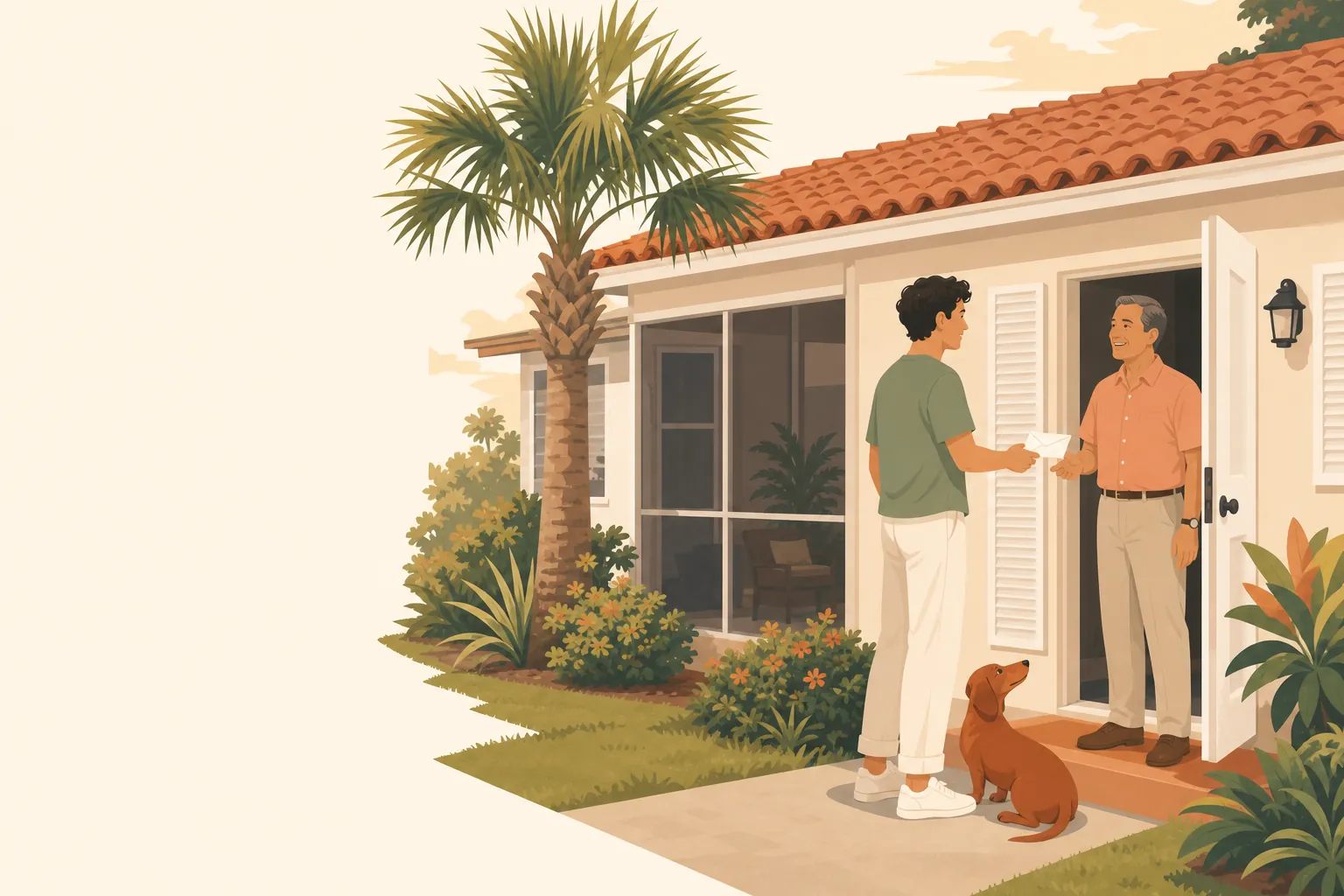
Illustrative exchange
Most refusals are not a flat no. They are a question the housing provider is not allowed to ask, or a fee they are not allowed to charge. Here is the shape of a typical exchange in Florida, with the rule beside each reply.
A made-up exchange to show the rules, not a real tenant or landlord.
Pet fees and deposits
Once your animal is accepted as a reasonable accommodation, you "may not be required to pay extra compensation for such animal" (§ 760.27(2)): no pet deposit, no pet fee, no pet rent. You remain liable for any damage the animal does to the premises or to another person (§ 760.27(4)), and the landlord can claim that damage against your ordinary security deposit. Florida sets no cap on that deposit; it must come back within 15 days of move-out unless the landlord sends a written claim within 30 days, and you then have 15 days to object (§ 83.49(3)). The protection comes from Florida's own statute, not from federal guidance.
Small landlords
Florida copies the two federal exemptions and applies them to the ESA statute by name: "Nothing in ss. 760.23, 760.25, and 760.27 applies to" the two groups listed in § 760.29(1)(a). The first is a single-family house rented by a private owner who owns no more than three such houses, provided no broker or rental service is used and no discriminatory advertising is published (§ 760.29(1)(a)). The second is rooms or units in a building of no more than four families where the owner lives in one of them (§ 760.29(1)(a)). If your landlord fits either group, § 760.27 does not bind them, and neither does the accommodation clause in § 760.23. Religious organisations and private clubs have their own exemptions (§ 760.29(2)–(3)).
If your landlord says no
Phone: 850-488-7082 (Florida Relay 711 · toll-free 800-342-8170) · File a complaint
Deadline: One year from the last discriminatory act (§ 760.34(2)). Start with the Housing Discrimination Questionnaire, sent by email, fax or mail to the Office of Customer Service; there is no online portal. Filing is free, and the commission aims to complete its investigation within 100 days (§ 760.34(1)).
Court: State or federal court within two years of the act (§ 760.35(1)), and you do not need to go to the commission first (§ 760.34(4)). If you win, the court must order relief including injunctive relief, actual and punitive damages, and reasonable attorney fees and costs (§ 760.35(4)).
Retaliation: Coercing, intimidating, threatening or interfering with you for exercising these rights is itself unlawful (§ 760.37).
Most commission housing cases are dual-filed with HUD; if you have already filed with HUD, do not file a second complaint with the commission. Six local agencies also take fair-housing complaints: Broward County, Jacksonville, Orlando, Palm Beach County, Pinellas County and the City of Tampa.

Your envelope, item by item
Keep a dated copy of everything you send.
What to send your landlord
Two or three sentences asking for a reasonable accommodation for an emotional support animal under Fla. Stat. § 760.27. Name the animal and its species, date the request, and keep a copy. Your landlord may run a routine intake process, but cannot refuse you solely for not using it (§ 760.27(3)(b)).
A signed letter from a clinician with personal knowledge of your disability, acting within scope of practice (§ 760.27(2)(b)4). It states your disability-related need for this animal and leaves the diagnosis out. Florida sets no required contents, so no landlord form and no notary (§ 760.27(3)(b)).
The one extra thing a landlord may require: proof that the animal complies with state and local licensing and vaccination rules (§ 760.27(2)(e)). Your local pet licence record and the rabies vaccination record from your vet usually cover it. Keep them with the letter.
A decision, not a demand for your diagnosis or records (§ 760.27(3)(a)). If the answer is no, write down the date: your one-year commission deadline (§ 760.34(2)) and two-year court window (§ 760.35(1)) both run from it. If the landlord questions the letter, verification support from your clinician is included.
If your housing provider questions the letter, your clinician responds directly at no extra cost.
Florida renters by city
The rules do not change from city to city, because § 760.27 is a state statute and one agency covers the whole state. The Florida Commission on Human Relations takes housing complaints from anywhere in the state within one year (§ 760.34(2)). Six local offices sit on HUD's fair-housing partner list too. They are the Jacksonville Human Rights Commission (904-630-4911), the City of Tampa Office of Community Relations (813-274-5835), the City of Orlando Office of Human Relations (407-246-2122), the Pinellas County Office of Human Rights for St. Petersburg (727-464-4880), the Broward County Office of Equal Opportunity for Fort Lauderdale (954-357-7800) and the Palm Beach County Office of Equal Opportunity (561-355-4883). Renters in Miami, Hialeah and Cape Coral go straight to the commission. Because our clinicians licensed in Florida work by live video or phone, a renter in Cape Coral moves at the same pace as one in Jacksonville: free screening, one consultation, and if you qualify a signed PDF typically within 24 to 48 hours.
Myths in Florida
Florida runs an ESA registry, and an ID card, a vest or a printout from a registration site is what a landlord needs to see.
FactFlorida has no ESA registry, and the statute says an identification card, patch, certificate or similar registration obtained from the internet "is not, by itself, sufficient information" (§ 760.27(3)(c)). Only a clinician's letter based on personal knowledge does the job.
Florida requires a 30-day relationship with the clinician, two sessions, or a letter dated within the last 12 months.
FactNone of those appear in the statute. The test is personal knowledge of your disability and action within scope of practice (§ 760.27(2)(b)4); there is no waiting period, no session count and no expiry. A landlord may ask for current licensing and vaccination proof for the animal, which is a different thing (§ 760.27(2)(e)).
Florida law says the letter must come from a clinician licensed in Florida.
FactNot as a legal rule. Section 760.27(2)(b)4 also accepts a telehealth provider under § 456.47, including registered out-of-state clinicians, and an out-of-state licensee who has seen you in person at least once. Pet Support Letter chooses clinicians licensed in Florida for Florida letters because that route needs no registration, no compact privilege and no in-person history.
Task-trained dogs are a different document. If your dog performs trained tasks for a psychiatric disability, read about the psychiatric service dog (PSD) letter online, written after a real consultation.
Typical competitor price $159 — you save up to $60
The reasonable-accommodation letter you give your landlord, after a live clinical evaluation.
Both letters from one course of care, including the consultations for each.
For people who already have housing sorted and need psychiatric service dog documentation only.
Signed PDF within 24 to 48 hours of your consultation. Same-day evaluations are often available for early bookings. Read the guarantee and refund terms.
Why this letter holds up

Read the exact terms. Money-back guarantee: full refund if you do not qualify, and a full refund if your housing provider refuses the letter.
★★★★★I had a really positive experience from start to finish. The process was smooth, and I felt comfortable sharing everything without feeling rushed or judged. The questions were straightforward and easy to answer, and I really appreciated how respectful and understanding everyone was throughout the process. Having the opportunity to speak with a licensed professional afterward was also very helpful and added a lot of value to the experience. Overall, I’m very satisfied with the service
Hamza Khalid · Trustpilot, 2026-09
★★★★★Great service!! 5 stars hands down!
Jen Khan · Trustpilot, 2026-09
Read all Pet Support Letter reviews on Trustpilot. We show our own reviews only, word for word.
Florida FAQ
Through a licensed clinician who evaluates you and forms personal knowledge of your disability and your need for the animal (§ 760.27(2)(b)4). A therapist you already see can write it. With Pet Support Letter, you take a free screening, pay at checkout, meet a clinician licensed in Florida by video or phone, and if you qualify the signed PDF usually follows within 24 to 48 hours. Not everyone qualifies.
Only on grounds § 760.27 allows. A landlord may refuse an animal that is a direct threat to others' safety, health or property, where no other accommodation can reduce the threat (§ 760.27(2)(a)). They may also ask for reliable information when your disability or need is not apparent (§ 760.27(2)(b)–(c)). A no-pets policy, a telehealth consultation, or your refusal to disclose a diagnosis are not lawful grounds (§ 760.27(3)(a)). Owners exempt under § 760.29(1)(a) sit outside the statute.
Some do, and Florida gives them a narrow way to do it. They may ask for reliable information on your disability and your need when neither is apparent (§ 760.27(2)(b)–(c)), and they can check a clinician's licence through the Department of Health's licence-verification search. They may not call for your diagnosis or records (§ 760.27(3)(a)). If your landlord questions the letter, your clinician answers it at no extra charge.
Florida sets no required format, so the question is who wrote it and how. A document from a registration site, an ID card or a certificate "is not, by itself, sufficient information" (§ 760.27(3)(c)). A letter written without personal knowledge of your disability fails the reliability test (§ 760.27(2)(b)4). Falsifying or knowingly providing fraudulent ESA documents is a second-degree misdemeanour: up to 60 days in jail, a 500-dollar fine and 30 hours of community service (§ 817.265).
There is none for housing. Fla. Stat. § 760.27 came from SB 1084 in 2020 (ch. 2020-76), and no bill amended it in 2025 or 2026. The one nearby change is chapter 2026-179, effective 1 July 2026, which waived sovereign immunity for fair-housing suits under § 760.35(4), so public housing authorities and other government landlords can now be sued for damages. Your rights under the ESA statute are the same as they were in 2020.
Not from Pet Support Letter, and not from any clinician who follows § 760.27. The letter must rest on a licensed clinician's evaluation with personal knowledge (§ 760.27(2)(b)4), which takes clinical time. A therapist you already see may include it in your care. Our screening is free and needs no card; the consultation and letter cost $99, paid at checkout before you meet the clinician. If the clinician finds you do not qualify, the fee is refunded.
$99 for a housing letter, $149 together with a psychiatric service dog letter, or $79 for a PSD letter and consultation on its own. The consultation and landlord verification support are included, and the price is the same across every state.
Nearby states and resources
Sources
General information, not legal advice. Last reviewed 2026-10-06 by Darren Rafel, LCSW. Statutes change; we re-check each state page and record the date above.
Two-minute screening, confidential, no card. You will see your exact state timeline before anything is charged.
Start the free screening HIPAA-compliant intake · Licensed clinicians · Money-back guarantee: full refund if you do not qualify, and a full refund if your housing provider refuses the letter.