New York · NY

ESA letter New York: your housing rights in NYC and statewide, no waiting period, and which deadline is yours

Yes, in NYC and statewide. The State Human Rights Law names "the use of an animal" as a housing accommodation, with no training test, waiting period or letter-content rule (N.Y. Exec. Law § 296(18)(2)). Inside NYC, a cooperative dialogue and a written answer are owed (N.Y.C. Admin. Code § 8-107(28)). Your clinician must hold a New York licence. If you qualify, the signed PDF usually arrives within 24 to 48 hours. The price is $99, paid before the consultation.

3years

to file with the State Division of Human Rights, for acts on or after 15 February 2024

N.Y. Exec. Law § 297(5)
1year

to file with the NYC Commission on Human Rights if you live in the five boroughs

N.Y.C. Admin. Code § 8-109(e)
1month's rent

is the most any deposit or advance may be, for every tenant in the state

N.Y. Gen. Oblig. Law § 7-108(1-a)(a)
14days

for the landlord to return your deposit with an itemised statement

N.Y. Gen. Oblig. Law § 7-108(1-a)(e)

New York, with the capital marked

New York at a glance

The 7 things a renter in New York needs to know.

Each answer is one line, with the section of New York law it comes from. The detail is further down the page.

  1. 01

    Does New York have an emotional support animal law?

    Not under that name, but something rarer. The State Human Rights Law itself makes it unlawful for a landlord or managing agent to refuse reasonable accommodations (N.Y. Exec. Law § 296(18)). That includes "the use of an animal as a reasonable accommodation to alleviate symptoms or effects of a disability" (N.Y. Exec. Law § 296(18)(2)). There is no training test, no species rule and no documentation clause. The Division of Human Rights lists an emotional support animal "even if not professionally trained" on its own complaint form. A bill that would add definitions, letter rules and penalties, S9086, has sat in committee since 30 January 2026.

    N.Y. Exec. Law § 296(18)(2); § 296(2-a)(d)(2)
  2. 02

    Is there a waiting period or 30-day rule before an ESA letter?

    No. No statute, Division regulation, City provision or agency guidance sets a relationship length or a session count. None sets an in-person visit or an expiry date for the letter. The one rule on timing runs the other way. The NYC Commission on Human Rights says a housing provider may not demand documentation "dated within a certain time of the request". A single live evaluation can be enough if the clinician finds you qualify.

    N.Y. Exec. Law § 296(18)(2); CCHR ESA fact sheet
  3. 03

    Who can write my ESA letter in New York?

    A clinician licensed in New York: an LCSW, a psychologist, a mental health counsellor or a physician. The State Education Department's rule is that a practitioner serving a patient located in the state must hold a state licence, wherever the practitioner sits. Practising without one is a class E felony (N.Y. Educ. Law § 6512(1)). Diagnosis of mental disorders and disabilities sits within licensed clinical social work, not the LMSW licence (N.Y. Educ. Law § 7701(2)(a)). No statute names a profession for the letter. Guidance speaks of a healthcare provider, a therapist or a treatment provider.

    N.Y. Educ. Law §§ 6512(1), 7701(2)(a); NYSED telepractice guidance
  4. 04

    What changes inside New York City?

    A second layer of law. The City Human Rights Law requires a reasonable accommodation once the disability "is known or should have been known" (N.Y.C. Admin. Code § 8-107(15)(a)). Since Local Law 59 of 2018 the housing provider must hold a "cooperative dialogue within a reasonable time" (N.Y.C. Admin. Code § 8-107(28)(c)–(d)). It must also give "a written final determination identifying any accommodation granted or denied" (N.Y.C. Admin. Code § 8-107(28)(c)–(d)). The Commission's guidance names emotional support animals expressly. It bars demands for a specific form, a diagnosis, medical records or a date window. It is construed independently of state and federal law. The Commission's filing window is one year (N.Y.C. Admin. Code § 8-109(e)).

    N.Y.C. Admin. Code §§ 8-107(15)(a), (28)(c)–(d), 8-109(e)
  5. 05

    Can my landlord charge a pet deposit or pet fee for my emotional support animal?

    No statute answers that in words. The State housing agency, HCR, says an accommodation request may not be "conditioned on payment of a fee or deposit". It adds that a pet deposit or pet insurance is prohibited for an assistance animal. The NYC Commission says a provider "cannot preemptively charge any such fees" and may bill only actual damage. Both are guidance applying the statute, so ask for the waiver in your request. Separately, every tenant's deposit or advance is capped at one month's rent (N.Y. Gen. Oblig. Law § 7-108(1-a)(a)). Up-front fees are capped at a 20-dollar background check (N.Y. Real Prop. Law § 238-a(1)). The deposit comes back within 14 days (N.Y. Gen. Oblig. Law § 7-108(1-a)(e)).

    HCR assistance-animal FAQ; CCHR ESA fact sheet; N.Y. Gen. Oblig. Law § 7-108(1-a); N.Y. Real Prop. Law § 238-a
  6. 06

    Does my small landlord have to follow this?

    Probably, and the exemption is narrower than the federal one. The State law exempts the rental of a unit in an owner-occupied building of "not more than two families" (N.Y. Exec. Law § 296(5)(a)(4)). It also exempts a room let by a resident owner or occupant (N.Y. Exec. Law § 296(5)(a)(4)). That wording is attached to the refusal-to-rent clauses. The accommodation duty in subdivision 18 carries no exemption of its own. No ruling has tested the gap, so a two-family owner-occupier may be exempt. Inside NYC the exemption applies only if the unit "has not been publicly advertised, listed, or otherwise offered to the general public" (N.Y.C. Admin. Code § 8-107(5)(a)(4)). Publicly-assisted housing has no exemption at all.

    N.Y. Exec. Law § 296(5)(a)(4); N.Y.C. Admin. Code § 8-107(5)(a)(4)
  7. 07

    How long do I have to complain, and can my landlord punish me for asking?

    Pick one forum; the clocks differ. The State Division of Human Rights takes a complaint within three years of the act (N.Y. Exec. Law § 297(5)). That window applies to acts on or after 15 February 2024 (N.Y. Exec. Law § 297(5)). The NYC Commission on Human Rights takes one within one year (N.Y.C. Admin. Code § 8-109(e)). A court suit is open for three years under either law (N.Y. CPLR § 214(2); N.Y.C. Admin. Code § 8-502(d)). But filing with an agency generally bars a later suit on the same facts (N.Y. Exec. Law § 297(9)). Since 5 December 2025 retaliating against anyone who "requested a reasonable accommodation" is itself unlawful (N.Y. Exec. Law § 296(7)(iii), L.2025 ch. 600).

    N.Y. Exec. Law §§ 297(5), (9), 296(7)(iii); N.Y.C. Admin. Code §§ 8-109(e), 8-502(d)

New York law

N.Y. Exec. Law § 296(18) names "the use of an animal" as a housing accommodation; NYC law adds a cooperative dialogue and a written answer

The protection is written into the statute itself. The State Human Rights Law makes it unlawful for an owner, lessee, managing agent or anyone with the right to rent housing to refuse reasonable accommodations in rules, policies, practices or services (N.Y. Exec. Law § 296(18)). That duty expressly includes "the use of an animal as a reasonable accommodation to alleviate symptoms or effects of a disability" (N.Y. Exec. Law § 296(18)(2)). Publicly-assisted housing carries the same clause (N.Y. Exec. Law § 296(2-a)(d)(2)). Nothing in it requires training, a species, a letter format or a waiting period. The landlord may ask for documentation of a disability and a related need when neither is obvious. A refusal has to rest on a ground the law allows, such as undue hardship. Disability is defined widely. An impairment "demonstrable by medically accepted clinical or laboratory diagnostic techniques" qualifies, with no "substantially limits" test (N.Y. Exec. Law § 292(21)). Inside NYC the City Human Rights Law adds a second duty (N.Y.C. Admin. Code § 8-107(28)). That duty is a "cooperative dialogue within a reasonable time" and "a written final determination identifying any accommodation granted or denied" (N.Y.C. Admin. Code § 8-107(28)(c)–(d)), with exemptions "construed narrowly". Complaints go to the State Division of Human Rights within three years (N.Y. Exec. Law § 297(5)). In the City, they go to the Commission on Human Rights within one year (N.Y.C. Admin. Code § 8-109(e)).

Source: N.Y. Exec. Law § 296(18)(2) (State Human Rights Law, Executive Law art. 15; page revision 5 June 2026). This is general information, not legal advice.

ComplaintsNew York State Division of Human Rights · (844) 697-3471 · complaint within three years (N.Y. Exec. Law § 297(5)). Inside NYC, alternatively the NYC Commission on Human Rights · 311 or (212) 416-0197 · within one year (N.Y.C. Admin. Code § 8-109(e)).PenaltyNo offence for misrepresenting an emotional support animal or a service animal exists in state law. The only proposal, S9086, would make it a misdemeanour with a fine of up to 500 dollars. It has sat in committee since 30 January 2026. A letter-writer who practises without a state licence commits a class E felony (N.Y. Educ. Law § 6512(1)).

The federal Fair Housing Act still recognises the accommodation, and you can still enforce it in court. Since May 2026, HUD itself has stopped pursuing complaints about untrained emotional support animals, so in practice your protection comes from New York law, the New York State Division of Human Rights and, inside the City, the NYC Commission on Human Rights.

“the use of an animal as a reasonable accommodation to alleviate symptoms or effects of a disability”

N.Y. Exec. Law § 296(18)(2)

Federal vs New York

Where the federal Fair Housing Act stops and New York law takes over.

TopicFederal (Fair Housing Act)New York
Fees and depositsThe federal statute and 24 C.F.R. § 100.204 set no fee rule. HUD's no-fee guidance was withdrawn on 17 September 2025. A waiver is therefore something you request as part of the accommodation.No statute bans an ESA pet fee in words. HCR and the NYC Commission say a provider may not condition the animal on a pet fee, deposit or extra insurance. A provider may charge only actual damage. For every tenant, any deposit or advance is capped at one month's rent (N.Y. Gen. Oblig. Law § 7-108(1-a)). Up-front fees are capped at a 20-dollar check (N.Y. Real Prop. Law § 238-a). The deposit is due back in 14 days (N.Y. Gen. Oblig. Law § 7-108(1-a)).
DocumentationThe request must be for an accommodation that is necessary because of a disability (42 U.S.C. § 3604(f)(3)(B)). No federal statute fixes a letter format.The landlord "may request medical information, when necessary to support that there is a covered disability" and a related need, per the Division's model notice (9 NYCRR § 466.15(e)). In NYC: a health professional's statement, with no diagnosis, no medical records, no specific form and no date window (CCHR guidance; N.Y.C. Admin. Code § 8-107(15)).
TimingNo federal waiting period for the letter and no federal deadline for the landlord's answer.No waiting period, session count or in-person rule for the clinician, and no statutory response deadline statewide. Inside NYC the provider owes a "cooperative dialogue within a reasonable time" and a written final determination (N.Y.C. Admin. Code § 8-107(28)(c)–(d)).
Who may writeFederal law does not say who may write the letter.No statute names a profession; guidance accepts a healthcare provider, a therapist or a treatment provider (9 NYCRR § 466.15(e); HCR FAQ). The clinician must hold a state licence to serve a patient located here. Unlicensed practice is a class E felony (N.Y. Educ. Law § 6512(1)).
ExemptionsA building of four or fewer units where the owner lives, and some single-family homes an owner rents out personally (42 U.S.C. § 3603(b)).Narrower: an owner-occupied building of "not more than two families", or rooms let by a resident owner or occupant, may be exempt (N.Y. Exec. Law § 296(5)(a)(4)). In NYC that applies only if the unit was never publicly advertised (N.Y.C. Admin. Code § 8-107(5)(a)(4)). Publicly-assisted housing has none.
Where to fileHUD, which since May 2026 finds cause only where the animal is trained, or a federal court.The State Division of Human Rights, a HUD partner agency, online or on (844) 697-3471. In the five boroughs, the NYC Commission on Human Rights via 311. The Westchester County commission, also a HUD partner, or Nassau County's commission. Or court without filing first (N.Y. Exec. Law § 297(9)).
DeadlineOne year to complain to HUD (42 U.S.C. § 3610); two years to sue in federal court (42 U.S.C. § 3613(a)(1)(A)).Three years to the Division (N.Y. Exec. Law § 297(5)). One year to the NYC Commission (N.Y.C. Admin. Code § 8-109(e)). Three years to court under the State law (N.Y. CPLR § 214(2)) or the City law, paused while an agency case is pending (N.Y.C. Admin. Code § 8-502(d)).

Swipe sideways to see the whole table.

Your timeline in New York

What actually happens, and when.

Nothing in state or City law makes you wait. There is no relationship minimum, no session count and no in-person rule. The NYC Commission bars a landlord from demanding a letter dated inside a set window. The pace is set by the clinical evaluation. The screening is free with no card; you pay at checkout before the consultation.

Step 1

A free screening with no card. A few questions about where you live, which borough or county, your animal and how it helps you. It decides nothing. It tells you whether a consultation makes sense and lets us confirm you are located in the state. That is what the licence rule turns on.

Step 2

Pay at checkout, then a live video or phone consultation with a clinician licensed in New York. The Education Department treats a video session with a patient located here as practice here. So the state licence governs (NYSED telepractice guidance). The clinician decides whether you have a disability as the state defines it (N.Y. Exec. Law § 292(21)). The clinician also decides whether the animal alleviates its symptoms or effects. Not everyone qualifies.

Step 3

If you qualify, your signed PDF usually arrives within 24 to 48 hours of the consultation. It uses the statute's own words, that the animal alleviates symptoms or effects of a disability (N.Y. Exec. Law § 296(18)(2)). It carries the clinician's licence type and number and the consultation date, and states no diagnosis. If you do not qualify, ask for a full refund within 7 days.

Housing

What your New York landlord may and may not do.

Under the federal Fair Housing Act (42 U.S.C. § 3604(f)(3)(B)) and New York's own fair-housing law, a housing provider must consider a reasonable-accommodation request for an assistance animal, including where pets are prohibited. Each line below carries the section it comes from.

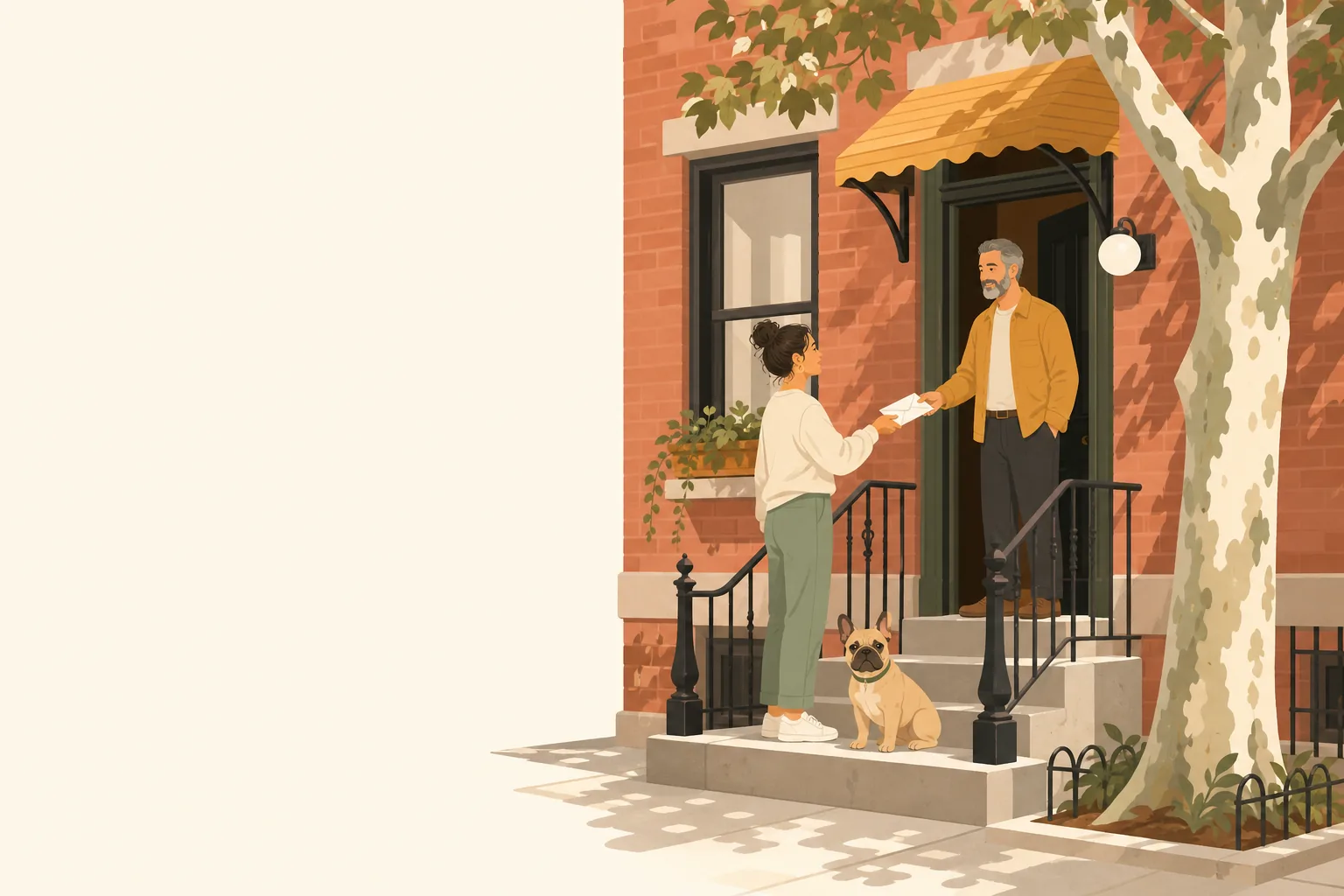
Illustration of a renter handing a letter to a landlord at the door of a New York home, a small dog at their feet

What they may do

Your landlord may

  • Ask for documentation of a covered disability and a disability-related need when neither is obvious. The Division's model notice says a provider "may request medical information, when necessary". 9 NYCRR § 466.15(e); HCR FAQ
  • Inside NYC, ask for a health professional's statement that you have a disability and that the animal "does or would ameliorate one or more symptoms or effects". Also ask for vaccination information for a dog. N.Y.C. Admin. Code § 8-107(15); CCHR ESA fact sheet
  • Require the animal to be leashed or harnessed in common areas. Hold you responsible for actual damage or excessive wear and tear. CCHR ESA fact sheet; HCR FAQ
  • Refuse or withdraw an accommodation that causes undue hardship, such as documented damage or disruption, or an animal the City prohibits on health grounds. The provider bears the burden of proving hardship. N.Y.C. Admin. Code § 8-102; CCHR ESA fact sheet
  • Deduct documented damage beyond ordinary wear and tear from the deposit, with an itemised statement inside 14 days of move-out. N.Y. Gen. Oblig. Law § 7-108(1-a)(b), (e)

What they may not do

Your landlord may not

  • Refuse "the use of an animal as a reasonable accommodation to alleviate symptoms or effects of a disability", in private or publicly-assisted housing. N.Y. Exec. Law § 296(18)(2); § 296(2-a)(d)(2)
  • Retaliate against you because you "requested a reasonable accommodation", a protection in force since 5 December 2025. N.Y. Exec. Law § 296(7)(iii), L.2025 ch. 600
  • Skip the written notice of accommodation rights owed to every new tenant within 30 days, in 12-point type with a named contact. In NYC, skip the cooperative dialogue and the written final determination. 9 NYCRR § 466.15(d); N.Y.C. Admin. Code § 8-107(28)(c)–(d)
  • Insist on a specific form, your diagnosis, your medical records or a letter dated within a set window. Charge a pet fee, pet deposit or extra insurance up front for an assistance animal, per State and City guidance. CCHR ESA fact sheet; HCR FAQ
  • Take more than one month's rent as a deposit or advance. Charge up-front fees beyond a 20-dollar background and credit check. Keep the deposit past 14 days without an itemised statement. N.Y. Gen. Oblig. Law § 7-108(1-a); N.Y. Real Prop. Law § 238-a

Illustrative exchange

What a lawful conversation looks like.

Most refusals are not a flat no. They are a question the housing provider is not allowed to ask, or a fee they are not allowed to charge. Here is the shape of a typical exchange in New York, with the rule beside each reply.

A made-up exchange to show the rules, not a real tenant or landlord.

Pet fees and deposits

No statute in this state says in words that a landlord may not charge a pet fee or pet deposit for an emotional support animal. The no-fee position is agency guidance applying the accommodation duty in N.Y. Exec. Law § 296(18)(2). The State housing agency, HCR, writes that a request "may not be unreasonably denied, or conditioned on payment of a fee or deposit". It adds that a pet deposit or pet insurance is prohibited for an assistance animal. The NYC Commission on Human Rights writes that a provider "cannot preemptively charge any such fees or require additional insurance coverage". The same guidance allows a charge for "actual damage or excessive wear and tear" only. Treat the waiver as something you ask for in the accommodation request, citing that guidance, not as a statutory ban. What statute does fix applies to every tenant, animal or not. Any deposit or advance is capped at one month's rent (N.Y. Gen. Oblig. Law § 7-108(1-a)(a)). No other payment, fee or charge may be demanded before or at the start of the tenancy (N.Y. Real Prop. Law § 238-a(1)). The one exception is a background and credit check capped at actual cost or 20 dollars, whichever is less (N.Y. Real Prop. Law § 238-a(1)). A late fee waits five days and tops out at 50 dollars or 5 percent of the rent (N.Y. Real Prop. Law § 238-a(2)). Within 14 days of move-out the landlord must return the deposit with an itemised statement or forfeit the right to keep any of it, and nothing may be kept for ordinary wear and tear (N.Y. Gen. Oblig. Law § 7-108(1-a)(b), (e)). A wilful violation can cost up to twice the deposit in punitive damages (N.Y. Gen. Oblig. Law § 7-108(1-a)(g)). The cap does not reach rent-controlled units and some senior and care facilities (N.Y. Gen. Oblig. Law § 7-108(1-a)).

Small landlords

The exemption is narrower than the federal four-unit rule. Its reach is untested. The State Human Rights Law exempts the rental of a unit in a building that holds "not more than two families living independently of each other, if the owner resides in one" (N.Y. Exec. Law § 296(5)(a)(4)). It also exempts rooms rented by a resident owner or occupant (N.Y. Exec. Law § 296(5)(a)(4)). That exemption is written for the refusal-to-rent and terms clauses. The accommodation duty in subdivision 18 carries no exemption of its own. No court or Division ruling has settled whether one reaches the other. A two-family owner-occupier may be exempt, so get advice before relying on either side. Publicly-assisted housing has no small-building exemption (N.Y. Exec. Law § 296(2-a)). Inside NYC the City law keeps the owner-occupied two-family exemption only where the unit "has not been publicly advertised, listed, or otherwise offered to the general public" (N.Y.C. Admin. Code § 8-107(5)(a)(4)). Its exemptions are construed narrowly (N.Y.C. Admin. Code § 8-107(5)(a)(4)). Never rely on a "four or fewer units" claim. That figure is federal.

If your landlord says no

New York State Division of Human Rights

Phone: (844) 697-3471 · File a complaint

Deadline: Three years from the act, for acts on or after 15 February 2024 (N.Y. Exec. Law § 297(5), extended from one year by L.2023 ch. 656). Filing is free, online, and needs no lawyer. In housing cases the complaint is served within 30 days (N.Y. Exec. Law § 297(2)(b)). The probable-cause decision is due within 100 days of filing (N.Y. Exec. Law § 297(2)(b)). Inside the five boroughs you may file instead with the NYC Commission on Human Rights within one year, by 311 or (212) 416-0197 (N.Y.C. Admin. Code § 8-109(e)). The Commission will not take a case already filed with the Division, HUD or a court.

Court: A suit is open for three years under the State law (N.Y. CPLR § 214(2)). It is open for three years under the City law, paused while an agency complaint is pending (N.Y.C. Admin. Code § 8-502(d)). Filing with the Division or the Commission is an election that generally bars a court suit on the same facts (N.Y. Exec. Law § 297(9); N.Y.C. Admin. Code § 8-502(a)). In a Division housing case either side may move the case to court within 20 days of a probable-cause finding (N.Y. Exec. Law § 297(9)). The Division can award punitive damages of up to 10,000 dollars in housing cases (N.Y. Exec. Law § 297(4)(c), (10)). It can also award civil fines of up to 50,000 dollars, or 100,000 dollars if wilful, and attorney's fees (N.Y. Exec. Law § 297(4)(c), (10)). A federal suit stays open for two years.

Retaliation: A landlord may not "retaliate or discriminate against any person" because they "requested a reasonable accommodation" (N.Y. Exec. Law § 296(7)(iii), L.2025 ch. 600). That clause has been in force since 5 December 2025 and applies to every action filed from that date (N.Y. Exec. Law § 296(7)(iii), L.2025 ch. 600).

The Division is HUD's Fair Housing Assistance Program partner for the state, as is the Westchester County Human Rights Commission. The NYC Commission is not. File under state or City law rather than with HUD, which now pursues only trained-animal cases. Nassau County's Commission on Human Rights, on 516-571-3662, also takes housing complaints within one year. One trap: the Division's model tenant notice still prints a one-year deadline (9 NYCRR § 466.15(e)). The statute's three years controls (N.Y. Exec. Law § 297(5)).


Illustration of a signed letter on letterhead with an envelope, a pen, a key and a calendar

Your envelope, item by item

  • A written request
  • The clinician's letter
  • What to leave out
  • What to expect back

Keep a dated copy of everything you send.

What to send your landlord

The request, the letter, and what happens next.

  1. 1

    A written request

    Three or four sentences. Say you have a disability and that your animal alleviates its symptoms or effects. Say you are asking for "the use of an animal as a reasonable accommodation" under N.Y. Exec. Law § 296(18)(2). Name the animal and its species. Inside NYC, add that you expect a cooperative dialogue and a written determination (N.Y.C. Admin. Code § 8-107(28)). Date it, send it to the owner or managing agent, and keep a copy.

  2. 2

    The clinician's letter

    The signed letter from a clinician licensed in New York, on letterhead. It shows the licence type and number and the consultation date. It states that you have a disability and that the animal alleviates symptoms or effects of it. That tracks the statute's words and the Commission's two-element test. It states no diagnosis. No statute sets any of this. It is what lets a landlord verify the licence on the Education Department's public lookup.

  3. 3

    What to leave out

    Your diagnosis, your medical records, a registry card, a vest and the landlord's own form. Statewide, a provider may obtain only the information needed to decide the request (HCR FAQ). Inside NYC the Commission bars demands for "a specific form or type of documentation", for the specific disability and for complete medical records (CCHR guidance; N.Y.C. Admin. Code § 8-107(15)). For a dog, vaccination proof is a fair ask.

  4. 4

    What to expect back

    Statewide there is no statutory response deadline, so ask for an answer in writing within a reasonable time. Inside NYC the answer must be a written final determination after a cooperative dialogue (N.Y.C. Admin. Code § 8-107(28)(d)). The City's own guidance suggests following up after two weeks of silence. A refusal, a form demand or a pet fee starts your clocks. You have three years at the Division (N.Y. Exec. Law § 297(5)) and one year at the Commission (N.Y.C. Admin. Code § 8-109(e)).

If your housing provider questions the letter, your clinician responds directly at no extra cost.

New York renters by city

The same rules from New York City to White Plains.

The housing right is the same in every one of the eight cities. It comes from the State Human Rights Law, and one statewide agency enforces it (N.Y. Exec. Law § 297(5)). A renter in Buffalo, Rochester, Syracuse or Albany files with the State Division of Human Rights within three years (N.Y. Exec. Law § 297(5)), online or on (844) 697-3471. What changes is the second door. In New York City the City Human Rights Law adds the cooperative dialogue and a written determination (N.Y.C. Admin. Code § 8-107(28)). The NYC Commission on Human Rights takes complaints within one year (N.Y.C. Admin. Code § 8-109(e)). A renter in Yonkers or White Plains can also use the Westchester County Human Rights Commission, a HUD partner agency. A renter in Hempstead has Nassau County's commission as well, within one year. Each filing is an election, so choose one forum. Co-op and condo boards get the same written request. The statute's duty falls on every "managing agent" and on anyone holding the right to rent or lease housing accommodations (N.Y. Exec. Law § 296(18)). Campus housing is housing too. A student in a dorm sends the same letter through the campus disability or housing office. The consultation is by video or phone with a clinician licensed in New York, so the timeline is identical in Astoria and in Albany. It is a free screening, one live consultation, and a signed PDF usually within 24 to 48 hours if you qualify. One City caution: an animal the City prohibits on health grounds cannot be an emotional support animal. The Commission lists that as a lawful ground to refuse (CCHR ESA fact sheet).

  • New York City
  • Buffalo
  • Rochester
  • Yonkers
  • Syracuse
  • Albany
  • Hempstead
  • White Plains
  • New York City Inside the five boroughs two laws apply at once. The City one is tighter. The City Human Rights Law requires a reasonable accommodation once the disability is known or should have been known (N.Y.C. Admin. Code § 8-107(15)(a)). It also requires a "cooperative dialogue within a reasonable time" and "a written final determination identifying any accommodation granted or denied" (N.Y.C. Admin. Code § 8-107(28)(c)–(d)). Withholding that written answer is a violation on its own. The Commission on Human Rights names emotional support animals expressly. It says a provider may not demand a specific form, a diagnosis, medical records or a date-limited letter. A provider also may not charge pet fees or extra insurance up front. File with the Commission within one year of the last act, by 311 or (212) 416-0197 (N.Y.C. Admin. Code § 8-109(e)). It is not a HUD partner agency. It will not take a case already filed with the State Division, HUD or a court. So the Division's three-year window (N.Y. Exec. Law § 297(5)) is the alternative, not an add-on. The owner-occupied two-family exemption applies here only if the unit was never publicly advertised (N.Y.C. Admin. Code § 8-107(5)(a)(4)). A separate rule, the City Pet Law, waives a no-pet clause when a pet is kept openly for three months in a private building of three or more units without the landlord starting a court case (N.Y.C. Admin. Code § 27-2009.1). It is a pet rule, not an ESA rule. A bill to widen it was filed without action on 31 December 2025.
  • Hempstead Hempstead renters, and the rest of Nassau County, have a third route. The Nassau County Commission on Human Rights at 240 Old Country Road, Mineola, on 516-571-3662, takes housing complaints within one year of the act. It is not a HUD partner agency, so the State Division's three-year window (N.Y. Exec. Law § 297(5)) still runs alongside it. Each filing is an election. The City Human Rights Law stops at the Queens line, so the cooperative-dialogue rule does not reach Nassau (N.Y. Exec. Law § 296(18)(2); 9 NYCRR § 466.15). The State accommodation duty and the written-notice rule do (N.Y. Exec. Law § 296(18)(2); 9 NYCRR § 466.15).
  • White Plains White Plains is the seat of Westchester County, whose Human Rights Commission enforces the county's own human rights and fair housing laws. It is one of only two HUD Fair Housing Assistance Program agencies in the state, alongside the State Division (HUD FHAP list). It answers on (914) 995-9500 at 112 East Post Road. Its filing deadline is not stated on its pages. So treat the Division's three years (N.Y. Exec. Law § 297(5)) as the clock you can rely on. A Westchester renter, in White Plains or Yonkers, is outside the City law, so the cooperative-dialogue duty does not apply. The State accommodation duty does (N.Y. Exec. Law § 296(18)(2)).

Myths in New York

Three things you will read elsewhere that are not New York law.

Myth

You have one year to file a state complaint, and owner-occupied buildings of four or fewer units are exempt.

Fact

Both figures are wrong for this state. The Division of Human Rights takes a complaint within three years of the act, for acts on or after 15 February 2024 (N.Y. Exec. Law § 297(5)). One year is the NYC Commission's deadline (N.Y.C. Admin. Code § 8-109(e)). Four units is the federal exemption. Here it is an owner-occupied building of "not more than two families" (N.Y. Exec. Law § 296(5)(a)(4)). Inside NYC it applies only if the unit was never publicly advertised (N.Y.C. Admin. Code § 8-107(5)(a)(4)). Even the Division's own model tenant notice still prints "one year"; the statute controls.

Myth

Faking an emotional support animal is a crime in New York under Senate bill S9086, with fines.

Fact

S9086 is a bill, not a law. It would define emotional support animals, limit who may write documentation, let landlords reject telehealth-only letters and create a misdemeanour with a fine of up to 500 dollars. It has sat in the Senate Disabilities Committee since 30 January 2026 with no Assembly companion. Today no state offence covers misrepresenting an emotional support animal or a service animal. No relationship-length rule exists. The penalty that does exist falls on practitioners. Practising a licensed profession without a state licence is a class E felony (N.Y. Educ. Law § 6512(1)).

Myth

New York keeps an ESA registry, a certified animal is not refused, and the letter must list a licence number, type and issue date to count.

Fact

No registry, certificate or letter-content rule exists in state or City law. HCR calls certification or training proof unnecessary (HCR FAQ). The Commission bars rejecting a request for not using "a specific form or type of documentation" (CCHR ESA fact sheet). A registry card is not a clinician's finding. The accommodation can still be refused for undue hardship, such as documented damage or disruption (N.Y.C. Admin. Code § 8-102; CCHR ESA fact sheet). It can also be refused for an animal the City bans on health grounds (N.Y.C. Admin. Code § 8-102; CCHR ESA fact sheet). We print the licence number and date anyway, so a landlord can verify them.

Task-trained dogs are a different document. If your dog performs trained tasks for a psychiatric disability, read about the psychiatric service dog (PSD) letter online, written after a real consultation.

Same price in every state

ESA + PSD combination

$149 one time

Both letters from one course of care, including the consultations for each.

  • Everything in the housing letter
  • Psychiatric service dog letter included
  • Both consultations with a licensed clinician
  • One clinical record, two documents
Start free screening

PSD letter & consultation

$79 one time

For people who already have housing sorted and need psychiatric service dog documentation only.

  • Live consultation with a licensed clinician
  • Psychiatric service dog letter
  • Disability-related task documented
  • No housing letter included
Start free screening

Signed PDF within 24 to 48 hours of your consultation. Same-day evaluations are often available for early bookings. Read the guarantee and refund terms.

Why this letter holds up

Written to New York's rules, by a clinician a landlord can check.

Illustration of a renter on a video consultation with a clinician, a cat asleep on the desk
Every letter follows a live video or phone consultation with a clinician licensed in New York.
  • The clinician. A clinician licensed in New York evaluates you in a live video or phone consultation. Clinical review of this page: Darren Rafel, LCSW.
  • What the letter contains. Confirmation of a disability-related need for your animal, the animal it covers, and the clinician's licence type, number, jurisdiction and effective date, signed on letterhead. No diagnosis.
  • How a landlord verifies it. The licence number is checked against the state licensing board; if they ask us, the clinician confirms the letter is genuine without disclosing anything else.

The refund terms, in full

  • If you do not qualify. If the licensed clinician determines after your assessment that you do not meet the clinical criteria for an ESA or PSD letter, the assessment and letter fee is refunded in full. Requests must be made within 7 days of being notified that you did not qualify. The clinician's clinical determination is final.
  • If your housing provider refuses the letter. If your landlord, property manager or housing authority refuses to accept the letter, you get a full refund. Contact us within 30 days of receiving your letter with the written denial (or reasonable evidence of the refusal), your full name and the letter's issue date. We first apply complimentary landlord verification support and contact the housing provider on your behalf; if the refusal stands, the refund is issued.

Read the exact terms. Money-back guarantee: full refund if you do not qualify, and a full refund if your housing provider refuses the letter.

What clients say

★★★★★

I had a really positive experience from start to finish. The process was smooth, and I felt comfortable sharing everything without feeling rushed or judged. The questions were straightforward and easy to answer, and I really appreciated how respectful and understanding everyone was throughout the process. Having the opportunity to speak with a licensed professional afterward was also very helpful and added a lot of value to the experience. Overall, I’m very satisfied with the service

Hamza Khalid · Trustpilot, 2026-09

★★★★★

Great service!! 5 stars hands down!

Jen Khan · Trustpilot, 2026-09

Read all Pet Support Letter reviews on Trustpilot. We show our own reviews only, word for word.

What is on every Pet Support Letter: the items a housing provider can check.

New York FAQ

New York questions, answered from the statute.

Can a landlord deny an ESA in NY?

Only on lawful grounds. Statewide, refusing "the use of an animal as a reasonable accommodation" is unlawful (N.Y. Exec. Law § 296(18)(2)). A lawful refusal rests on undue hardship, which the provider must prove. The other lawful ground is an exemption, such as an owner-occupied two-family building (N.Y. Exec. Law § 296(5)(a)(4)). Inside NYC the Commission names documented damage or disruption and animals the City bans on health grounds. The decision comes after a cooperative dialogue and in writing (N.Y.C. Admin. Code § 8-107(28)).

How do they verify ESA letters?

By checking the clinician, not the animal. A landlord may ask for documentation of a disability and a related need when neither is obvious (9 NYCRR § 466.15(e)). What it can verify is the licence. A clinician serving a patient located here must hold a state licence, listed publicly by the Education Department. Our letter shows licence type, number and consultation date. The clinician confirms it if asked. Nobody may demand your diagnosis, records or a date-limited letter (CCHR guidance).

How to get an ESA letter immediately?

Nothing in state or City law makes you wait. The pace is the evaluation itself. Book the free screening, pay $99 at checkout, and meet a clinician licensed in New York by video or phone. If you qualify, the signed PDF usually arrives within 24 to 48 hours of that consultation. A registry card or a template is not a clinician's finding. HCR calls certification unnecessary. Not everyone qualifies; if you do not, the fee is refunded.

Will ESA laws change in 2026?

Two changes are in force; one is pending. Since 15 February 2024 the State Division's filing window is three years, not one (N.Y. Exec. Law § 297(5)). Since 5 December 2025 retaliation for requesting an accommodation is itself unlawful (N.Y. Exec. Law § 296(7)(iii)). S9086, adding ESA definitions, letter rules and a misdemeanour, has sat in committee since 30 January 2026. HUD's May 2026 memo changed only federal enforcement. State and City agencies still take untrained-animal cases.

What qualifies you for an emotional support pet?

A disability as the State law defines it, plus a disability-related need the animal meets. The definition is wider than the federal one. It covers an impairment that "prevents the exercise of a normal bodily function or is demonstrable by medically accepted clinical or laboratory diagnostic techniques" (N.Y. Exec. Law § 292(21)). There is no "substantially limits" test (N.Y. Exec. Law § 292(21)). A diagnosis label alone does not settle it. A clinician licensed in New York has to find both elements, and not everyone qualifies.

How many emotional support animals can I legally have?

No statute sets a number. HCR's guidance says more than one animal can qualify, with documentation of a disability-related need for each (HCR FAQ). A second animal with no need of its own is a pet. Each is still subject to undue hardship. Documented damage or disruption from any animal can end its accommodation (N.Y.C. Admin. Code § 8-102; CCHR ESA fact sheet). Any species can qualify subject to reasonableness, except animals the City bans on health grounds.

How much does an ESA letter cost in New York?

$99 for a housing letter, $149 together with a psychiatric service dog letter, or $79 for a PSD letter and consultation on its own. The consultation and landlord verification support are included, and the price is the same across every state.

Sources

Every legal statement on this page, and where it comes from.

  1. N.Y. Exec. Law § 296 (State Human Rights Law: §§ 296(18)(2), 296(2-a)(d)(2) animal clause; 296(5)(a)(4) exemptions; 296(7)(iii) retaliation) accessed 2026-10-13
  2. N.Y. Exec. Law § 297 (complaint procedure: three-year filing window, election of remedies, remedies) accessed 2026-10-13
  3. N.Y. Exec. Law § 292 (definitions, including § 292(21) disability) accessed 2026-10-13
  4. N.Y. Gen. Oblig. Law § 7-108 (security deposits: one-month cap, 14-day return, punitive damages) accessed 2026-10-13
  5. N.Y. Real Prop. Law § 238-a (up-front fees limited to a 20-dollar background check; late-fee cap) accessed 2026-10-13
  6. N.Y. Educ. Law § 6512 (unauthorised practice of a profession: class E felony) accessed 2026-10-13
  7. N.Y. Educ. Law § 7701 (scope of licensed clinical social work, including diagnosis) accessed 2026-10-13
  8. N.Y. CPLR § 214 (three-year limitation for statutory liabilities) accessed 2026-10-13
  9. S9086 (2026), proposed ESA definitions, documentation rules and misdemeanour; in committee since 30 January 2026 accessed 2026-10-13
  10. A4898 / S3398, Reasonable Accommodation Anti-Retaliation Act, L.2025 ch. 600 (signed 5 December 2025) accessed 2026-10-13
  11. New York State Division of Human Rights, Report Discrimination (three-year window; (844) 697-3471) accessed 2026-10-13
  12. New York State Division of Human Rights, online discrimination report form (housing branch lists an emotional support animal "even if not professionally trained") accessed 2026-10-13
  13. 9 NYCRR Part 466 (§ 466.15: notice of accommodation rights to tenants; model notice) accessed 2026-10-13
  14. NYS Homes and Community Renewal, assistance-animal FAQ (no pet deposit or insurance for an assistance animal; certification unnecessary; more than one animal) accessed 2026-10-13
  15. NYS Education Department, Office of the Professions, social work telepractice guidance (New York licence required for a patient located in New York) accessed 2026-10-13
  16. N.Y.C. Admin. Code Title 8, ch. 1 (§§ 8-102, 8-107(5), (15), (28), 8-109(e)) accessed 2026-10-13
  17. N.Y.C. Admin. Code Title 8, ch. 5 (§ 8-502: civil action, three-year window tolled during an agency case) accessed 2026-10-13
  18. NYC Commission on Human Rights, Legal Enforcement Guidance on Disability Discrimination (emotional support animals; cooperative dialogue; documentation limits) accessed 2026-10-13
  19. NYC Commission on Human Rights, Emotional Support Animals in Housing fact sheet accessed 2026-10-13
  20. NYC Commission on Human Rights, complaint process (one-year deadline; 311 or (212) 416-0197; updated 24 April 2026) accessed 2026-10-13
  21. NYC Animal Welfare, evictions and the Pet Law (N.Y.C. Admin. Code § 27-2009.1, three-month rule) accessed 2026-10-13
  22. Westchester County Human Rights Commission (county Human Rights Law and Fair Housing Law; (914) 995-9500) accessed 2026-10-13
  23. Nassau County Commission on Human Rights (housing covered; one-year filing window; 516-571-3662) accessed 2026-10-13
  24. HUD list of Fair Housing Assistance Program agencies (New York State Division of Human Rights; Westchester County Human Rights Commission) accessed 2026-10-13
  25. HUD FHEO enforcement memorandum, 22 May 2026 accessed 2026-10-13

General information, not legal advice. Last reviewed 2026-10-13 by Darren Rafel, LCSW. Statutes change; we re-check each state page and record the date above.

Check if you qualify in New York.

Two-minute screening, confidential, no card. You will see your exact state timeline before anything is charged.

Start the free screening HIPAA-compliant intake · Licensed clinicians · Money-back guarantee: full refund if you do not qualify, and a full refund if your housing provider refuses the letter.